
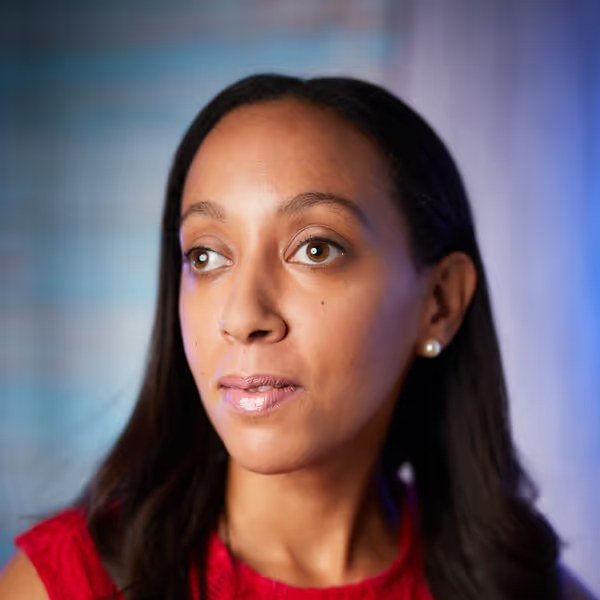
Haben Girma was born deafblind, and she has spent her life opening conversations that were never designed to include her.
She was born in 1988 in Oakland, California, to parents who had fled Eritrea and Ethiopia, and who knew what it meant to start again in a new country.
Growing up deafblind in Oakland
At school she kept meeting information she could not reach: instructions given out loud, notes written on a board, forms handed across a desk.
She learned early to say what she needed, and to keep saying it until someone listened.
As a teenager she found something wonderful at a camp for blind youth. While dancing, she could feel the rhythm of the music through her partner’s hands.
She also travelled to Mali with a school club to help build a school, talking with village children through gesture, touch and shared games.
She went on to Lewis & Clark College in Portland, Oregon, where she studied sociology and anthropology and graduated with honours in 2010.
At college the cafeteria had no menu she could read. When her request was refused, she pointed to the Americans with Disabilities Act, and the cafeteria agreed to provide accessible menus.
That exchange changed her direction. She had seen how much one clear request, backed by the law, could move.
Harvard Law, and one small keyboard
In 2010 she entered Harvard Law School as its first deafblind student, and in 2013 she graduated as its first deafblind graduate.
Classroom access was never simple. Lectures and conversations had to be made available to her, and the first solutions did not always work.
Then a classmate typed a message on her braille computer, and she had an idea: connect a wireless keyboard, so that anyone could type and she could read in braille.
That simple setup let her hold conversations in noisy rooms for the first time, and it showed how a small change can open a very large door.
Haben Girma and the case for digital access
After law school she joined Disability Rights Advocates, a nonprofit law firm in California, where she worked on disability civil rights cases.
There she heard from blind readers who could not use a large online digital library because the platform did not work with their screen readers.
When efforts to work with the company went nowhere, her legal team filed suit. The company argued that the Americans with Disabilities Act covered only physical places.
A federal judge ruled that the law could apply to online services, and the company later settled. Digital access had been treated, in law, as a civil rights question.
The White House named her a Champion of Change for that work, and in 2015 she spoke there for the twenty-fifth anniversary of the Americans with Disabilities Act, communicating through a braille display.
She reminded the audience that people with disabilities succeed through opportunity, not magic, and that laws and communities can create those opportunities.
In 2016 she began working as a speaker, writer and consultant, helping schools, companies and communities understand accessibility and inclusion.
In 2019 she published a memoir, “Haben: The Deafblind Woman Who Conquered Harvard Law,” telling the story in her own words.
Her message is clear: disability is not something she has to overcome. The biggest barriers are social, physical and digital, and communities can choose to remove them.
Haben Girma’s work asks a simple question of every school, workplace and website: who has been left out, and what would it take to let them in?
Haben Girma’s journey shows how one person’s insistence on being included can open doors for many others.
This is ProudGirls: celebrating women whose courage, creativity, and determination leave a lasting mark. Follow along, and share the story of a woman who inspires you.
Primary reference: Haben Girma’s official site and Wikipedia entry on Haben Girma. Explore the full ProudGirls roster for more dossiers.