
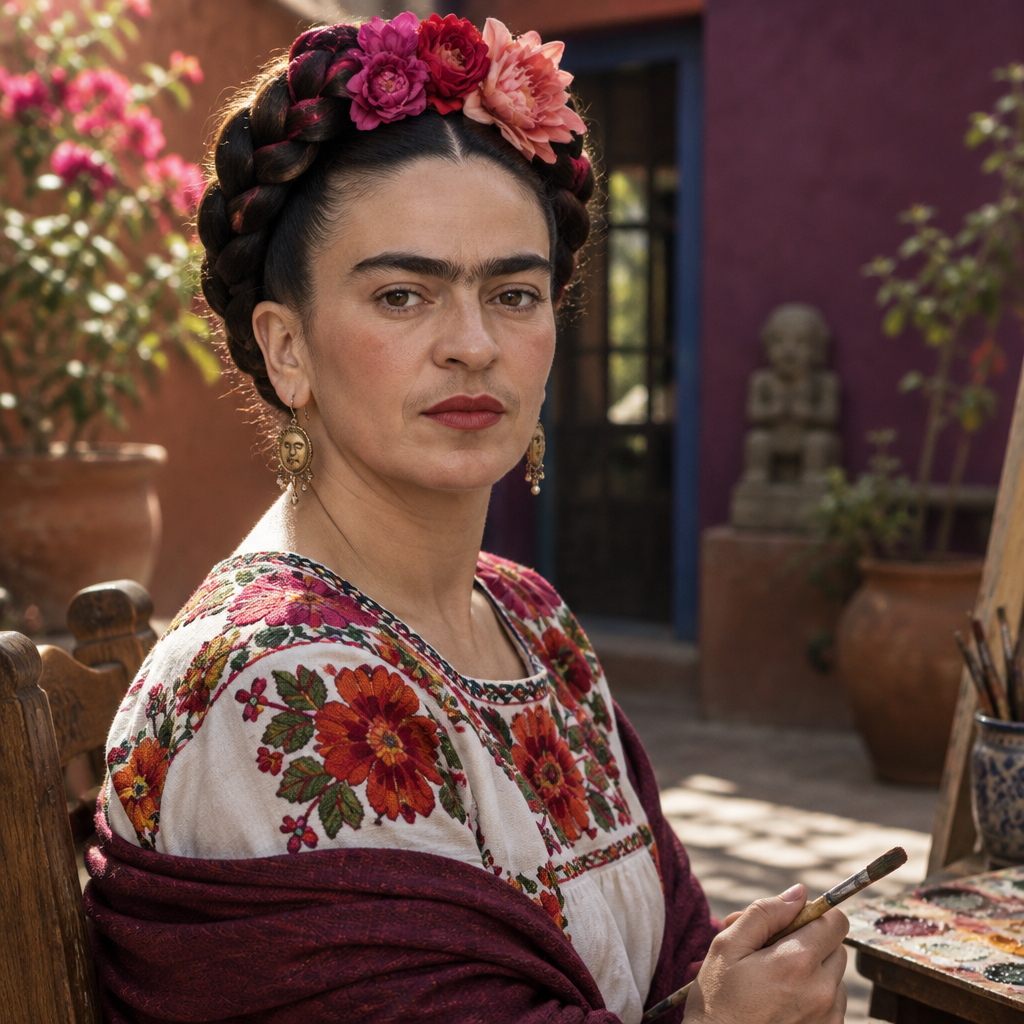
Some artists paint the world they see. Frida Kahlo painted the world she carried inside her, and in her case the Frida Kahlo life and art cannot be separated.
She was born in 1907 in Coyoacán, then a town on the edge of Mexico City. Its colors, traditions, and everyday life would remain part of her imagination.
As a young woman, Frida was curious, determined, and ambitious. She planned to study medicine, reflecting her interest in the human body and the world around her.
Then, in 1925, a serious bus accident left her with lasting injuries. Her recovery was long and difficult. The future she had imagined suddenly changed.
During that recovery, Frida began painting. Her family arranged a mirror so she could see herself while lying in bed. A new subject was always within reach.
However, that mirror became more than a practical tool. It gave her a way to study her face, her feelings, and the person she was becoming.
Frida returned to the self-portrait again and again. These were not simply pictures of appearance. They explored identity, memory, pain, and the complicated experience of being alive.
At the same time, her paintings drew on Mexican culture. Traditional clothing, folk art, plants, animals, and vivid colors became meaningful parts of a visual language that was unmistakably her own.
Frida Kahlo: a life told through art
She met the celebrated muralist Diego Rivera, and they married in 1929. Their relationship was complicated, and both artists continued to pursue their own work.
Frida’s art developed beyond any single relationship or label. She built a distinctive style through close observation, symbolism, and attention to personal experience.
Her paintings could be tender, startling, humorous, or unsettling. She used objects and symbols to express feelings that ordinary explanations could not easily contain.
Her work gradually reached audiences outside Mexico. The images were deeply personal, yet viewers in different places found ways to recognize their own questions in them.
By 1938, Frida held her first solo exhibition in New York. It brought wider attention to an artist whose work did not fit neatly into familiar categories.
A year later, she exhibited in Paris. Her paintings entered international conversations, while she continued to insist on the importance of her Mexican identity.
Although others connected her work with artistic movements, Frida resisted being defined by someone else’s label. She made art on her own terms.
Even so, her physical pain never disappeared. Operations and periods of illness shaped her daily life, but they did not erase her need to create, observe, and communicate.
Frida Kahlo and Mexican identity
Later she also taught young artists in Mexico, encouraging them to look closely at their surroundings and develop their own creative voices.
Her home, the Blue House in Coyoacán, was filled with art, color, objects, plants, and ideas. It remains closely connected to her story.
Across her work, Frida returned to questions of identity, belonging, love, loss, and resilience. She did not hide contradiction. She made room for it on the canvas.
Finally, in 1953, she held her first solo exhibition in Mexico. Too ill to move around easily, she arrived by ambulance and attended from a bed placed in the gallery.
Frida Kahlo died in 1954, aged 47. But the paintings she left behind continued to travel, challenge viewers, and invite new interpretations.
Today, people connect with her work for its honesty, imagination, cultural references, and refusal to make difficult experiences look simple. That is why the Frida Kahlo life and art still travels so widely.
Frida turned the details of her own life into art that speaks far beyond one lifetime. She showed that a personal story can become a powerful way to see the world.
This is ProudGirls: celebrating women whose courage, creativity, and determination leave a lasting mark. Follow along, and share the story of a woman who inspires you.
Primary reference: the Britannica entry. Explore the full ProudGirls roster for more dossiers.