
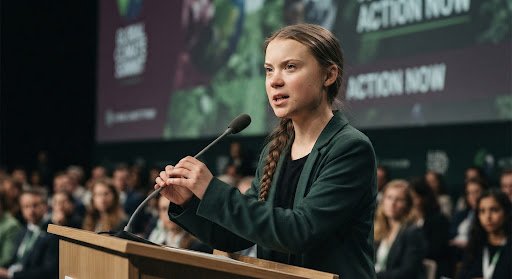
Before the crowds, before the cameras, there was one teenager sitting outside a parliament with a simple demand: take the climate crisis seriously. What followed became the Greta Thunberg school strike.
Her name was Greta Thunberg. In 2018, she was fifteen, a student in Sweden, and unwilling to accept that concern was enough.
She had learned about climate change as a child. The more she studied the evidence, the harder it became to understand why action seemed so slow.
She began asking a question that would shape her life: if adults knew the risks, why were governments not acting with greater urgency?
So, in August 2018, she began a school strike outside the Swedish Parliament in Stockholm, calling attention to climate change and political inaction.
For three weeks before Sweden’s national election, she returned to the same place on school days, making a quiet protest impossible to ignore.
At first, she was largely alone. Then other students, teachers, parents, and passersby began to notice—and some decided to join her.
After the election, the protest continued on Fridays. The name Fridays for Future turned the Greta Thunberg school strike into a shared movement.
Greta Thunberg and the school strike
Soon students began organizing climate strikes in cities and towns around the world. They did not all wait for one leader; they built local groups.
The message reached public forums and political institutions: listen to climate science, and match promises with meaningful decisions.
Then, in 2019, she addressed major international gatherings, bringing the urgency of young people’s concerns directly to political and business leaders.
At the United Nations climate action summit in New York, she challenged world leaders to confront the gap between their words and their actions.
Her speeches drew attention, but the foundation of the campaign was scientific evidence: rising greenhouse-gas emissions and the risks of a warming planet.
Across the world, young people marched peacefully, carrying handmade signs and demanding that climate policy reflect the scale of the challenge.
That same year, she crossed the Atlantic by sailboat to attend climate events in the United States, drawing attention to lower-emission travel.
But this story was never only about one person. Students, scientists, educators, and community organizers were building the movement together.
Greta Thunberg’s movement after the strike
When the COVID-19 pandemic disrupted public gatherings, climate organizing adapted. Many students shifted their actions online and continued sharing their message.
In 2022, she helped bring together The Climate Book, a collection of contributions from scientists, writers, and activists about the climate crisis and possible responses.
By 2023, she completed her school climate-strike chapter, while continuing to take part in public climate activism and debate.
Across communities, people kept working in different ways: documenting local problems, supporting solutions, organizing, and asking leaders to be accountable.
After all, the climate crisis has no single fix, and no single activist can solve it. Progress depends on science, policy, cooperation, and sustained public effort.
Meanwhile her influence helped make youth climate action visible. Yet the movement’s strength comes from many voices insisting that their future matters.
Return to the square where it began: what started as one student’s protest became a worldwide call for young people to participate in public life.
One voice can start a conversation. Many voices can keep it moving. This is ProudGirls—stories of courage, action, and the power to make a difference.
Primary reference: the United Nations youth climate page. Explore the full ProudGirls roster for more dossiers.