
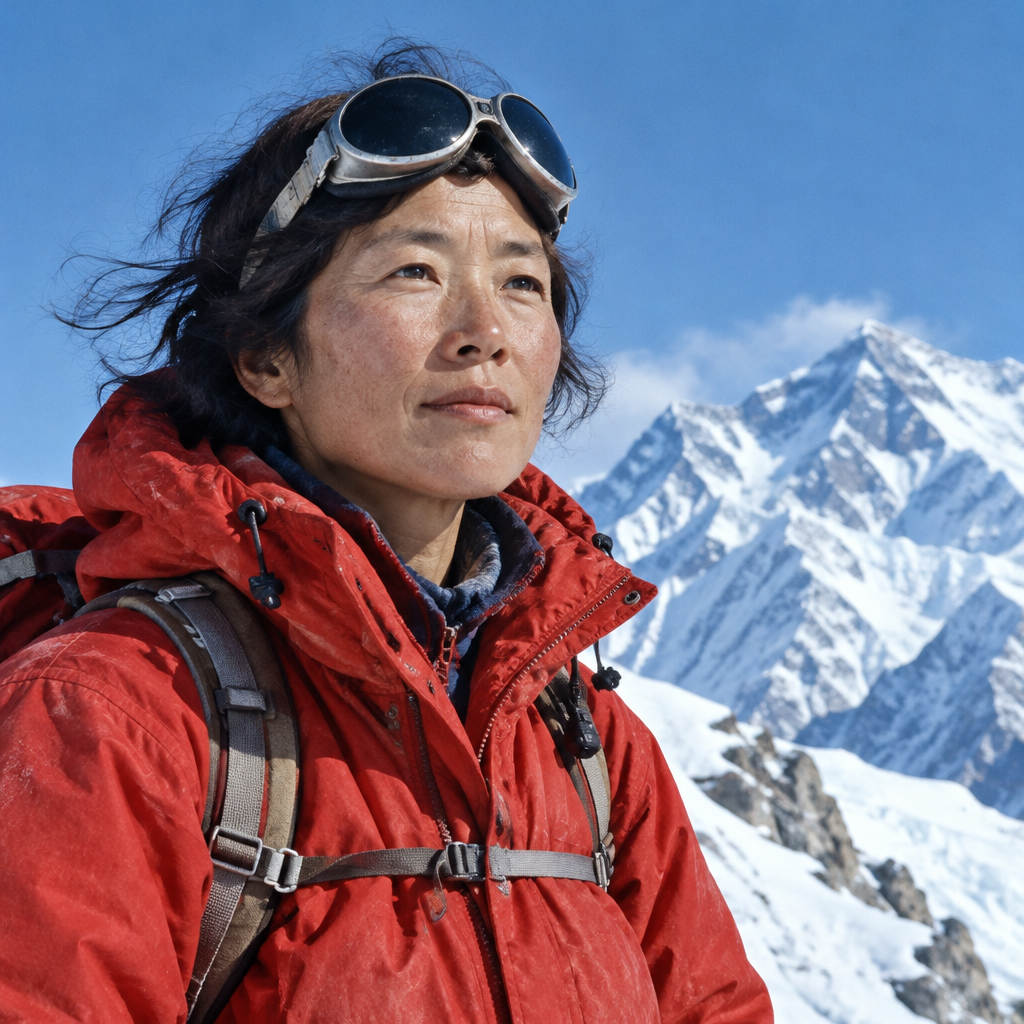
On May 16, 1975, a Japanese mountaineer stood on the highest point on Earth. No woman had ever been there before. Her name was Junko Tabei, the first woman to climb Everest.
Junko Tabei was born in 1939 in Miharu, a town in Fukushima, Japan. She was the fifth of seven children, and was often thought of as a frail child.
At age ten, she joined a class trip to climb Mount Nasu. The strange volcanic landscape amazed her, and it sparked a love of the mountains that never left her.
As a young woman, she studied English literature and education at Showa Women’s University and climbed many of Japan’s major mountains, including Mount Fuji.
But climbing was still seen as a man’s world. She often found that male climbers did not take her seriously, and few were willing to climb with her.
Then, in 1969, she helped found the Ladies Climbing Club, Japan. Its slogan was simple and bold: let’s go on an overseas expedition by ourselves.
Meanwhile she married fellow climber Masanobu Tabei, worked, and became a mother. At a time when many women were expected to stay home, she kept climbing.
In 1970, the club made its first overseas expedition, to Annapurna III in Nepal. On May 19, Tabei reached the summit, becoming the first woman to climb it.
First woman to climb Everest: Junko Tabei
Next came a bigger dream: Mount Everest. The club applied for a permit in 1971, but with limited places available, the team had to wait four years.
Even so, raising money was hard. Many doubted that a team of women could climb Everest, and the climbers even made some of their own expedition clothing.
Finally, in spring 1975, the Japanese Women’s Everest Expedition set out, supported by Sherpa climbers. Tabei was assistant leader, and the team worked together through weeks at high altitude.
By early May, the team had spent weeks on the mountain. After setting up high camps, they descended to Camp Two, at 6,300 meters, to rest.
Then, in the early hours of May 4, an avalanche struck. Tons of ice and snow buried several teammates. Tabei was trapped until Sherpa climbers pulled her free.
Although badly bruised, she insisted on staying on the mountain. The permit was precious, the dream was years in the making, and the expedition continued.
Twelve days later, she began the final climb with Sherpa climber Ang Tsering. Near the top, she crossed a narrow, exposed ridge, moving sideways with great care.
On May 16, 1975, Junko Tabei reached the summit of Mount Everest. She became the first woman to climb Everest.
Junko Tabei on the summit of Everest
Still, her summit belonged to a team. The women of the expedition, together with Sherpa climbers, worked to place her on top of the world.
Soon news of her achievement spread across Asia, leading to national celebrations in Japan, Nepal and India. She became a symbol of women’s progress.
After that, she kept climbing. On June 28, 1992, she reached Puncak Jaya in Indonesia, becoming the first woman to climb the highest peak on every continent.
Over the years, she climbed in more than seventy countries and joined dozens of all-women expeditions, encouraging other women to organize their own climbs.
In time, Tabei grew concerned about waste and damage on the mountains. She joined clean-up climbs and directed the Japanese branch of the Himalayan Adventure Trust.
After the 2011 earthquake and tsunami, she organized annual climbs of Mount Fuji for students from affected communities, helping them build confidence on the mountain.
Junko Tabei died in 2016, at age seventy-seven. The first woman to climb Everest spent her later years opening the mountains to others, and her story shows that persistence can open a path, and that a path opened by one woman can be followed by many.
This is ProudGirls: celebrating women whose courage, creativity, and determination leave a lasting mark. Follow along, and share the story of a woman who inspires you.
Primary reference: the Britannica entry. Explore the full ProudGirls roster for more dossiers.