
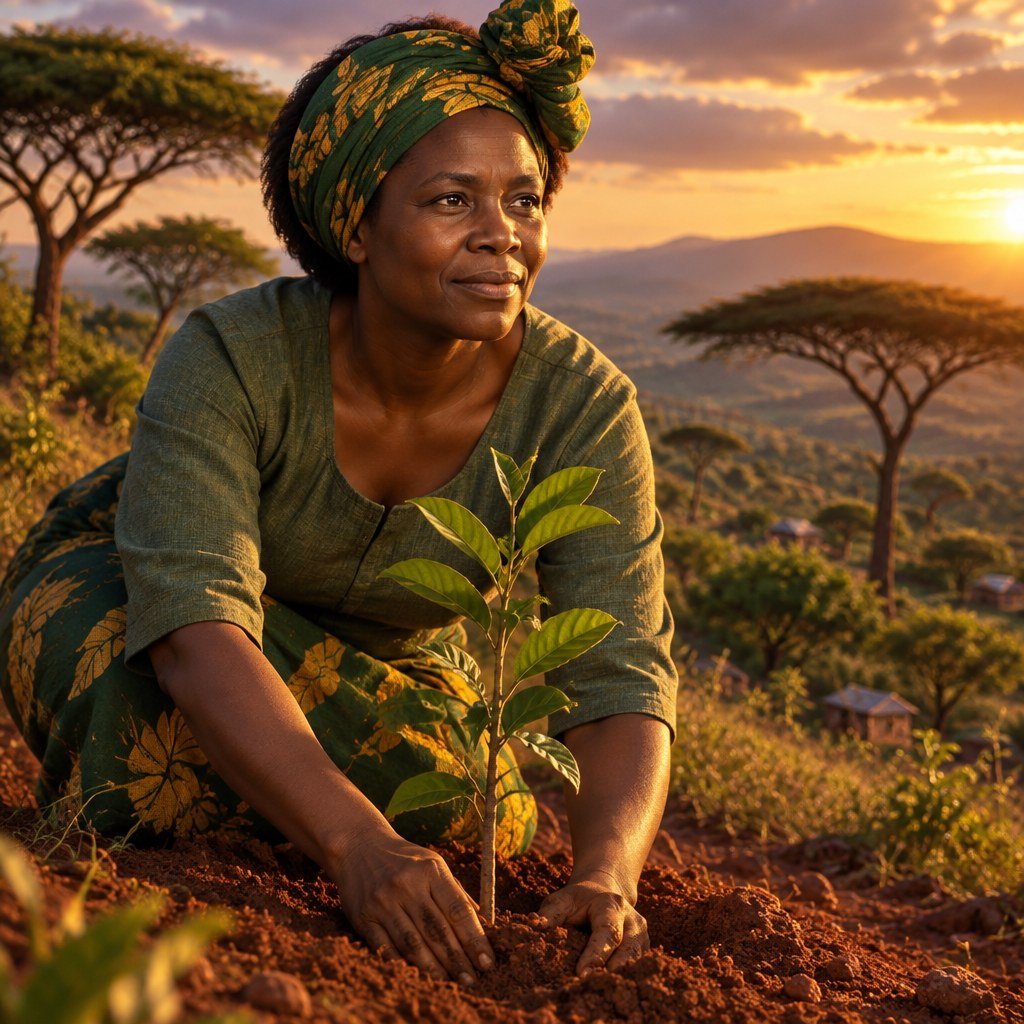
Imagine if planting one tree could become the beginning of a movement. For Wangari Maathai the Green Belt Movement began exactly that way.
In rural Kenya, women were facing a problem that reached far beyond the forest.
Her name was Wangari Maathai, and nature had shaped her thinking from childhood.
Because she valued learning, she pursued an education at a time when higher education was still unusual for many African girls.
She studied biological sciences in the United States, then continued her education with a master’s degree.
In 1971, she earned a Ph.D. from the University of Nairobi.
She became the first woman in East and Central Africa to earn a doctorate.
Then women began describing what environmental damage meant in everyday life: less firewood, less water, and less secure food.
Wangari Maathai and the Green Belt Movement
Therefore Wangari began connecting these problems to a simple idea: restore the land by planting trees.
So, in 1977, she founded the Green Belt Movement in Kenya.
The movement encouraged women to grow and plant trees in their own communities.
Soon what looked small began spreading from one community to another.
Tree planting became a way to restore the environment and strengthen local livelihoods.
But Wangari came to see that environmental problems were also connected to power, poverty, and people’s ability to shape their future.
Her environmental work increasingly became a fight to protect public spaces and defend civic rights.
Even so, she faced intimidation and opposition, and she continued speaking out.
Wangari Maathai: trees, democracy and courage
Her message grew: caring for the environment could also mean standing up for dignity, democracy, and peace.
In time, the idea had become much larger than planting trees.
It had become a grassroots movement built around the belief that ordinary people could create change.
In 2004, Wangari Maathai received the Nobel Peace Prize for her contribution to sustainable development, democracy, and peace.
She became the first African woman to receive the Nobel Peace Prize.
Her approach inspired environmental and civic action far beyond the communities where it began.
Wangari died in 2011, yet the Wangari Maathai Green Belt Movement continues to carry her vision forward.
Ultimately, the Wangari Maathai Green Belt Movement reminds us that change does not always begin with power. Sometimes, it begins with one person, one idea, and one small act. Her story. Her work. Her impact. Welcome to ProudGirls.
Primary reference: the Nobel Peace Prize citation. Explore the full ProudGirls roster for more dossiers.