
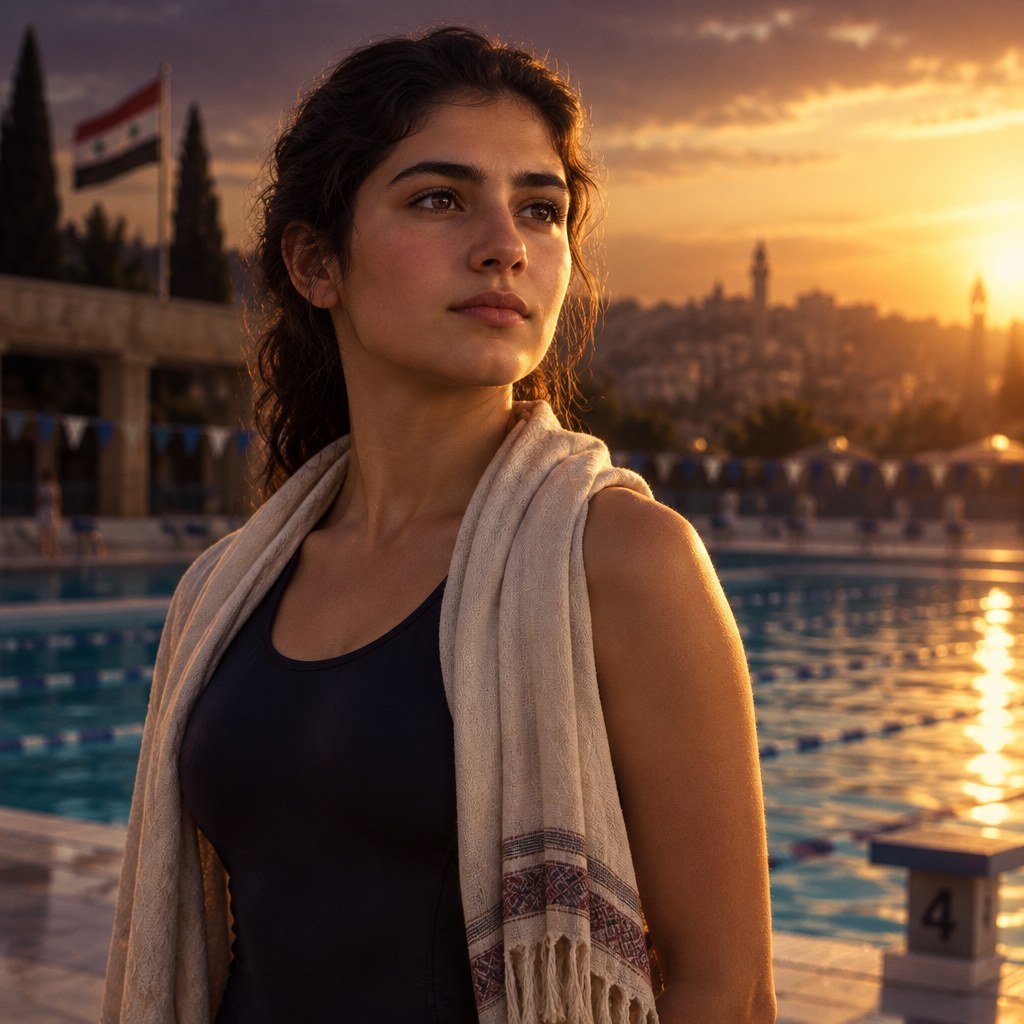
Imagine a small boat on open water. Its engine has failed. The shore is far away, and a young swimmer makes a decision that will change her life. That decision is where the Yusra Mardini true story begins.
Her name is Yusra Mardini. Born in Damascus, Syria, in 1998, she grew up with a dream that began in the swimming pool.
Her father taught her to swim when she was four. Water became a place of confidence, discipline, and possibility in a childhood shaped by sport.
By 2012, she was competing internationally for Syria, including at the short-course World Championships in Istanbul. She was a promising young swimmer with Olympic ambitions.
But conflict changed daily life. Training became difficult and sometimes impossible. The future she had imagined in the pool grew uncertain.
Then, in August 2015, at seventeen, Yusra left Syria with her older sister Sara. They hoped to reach safety and eventually reunite with their family.
From Turkey, the sisters boarded an overcrowded inflatable boat with eighteen other people, including families with children. The crossing toward the Greek island of Lesbos began.
Then the boat’s engine stopped. The small vessel began taking on water, and many passengers could not swim. The danger was immediate.
Yusra Mardini: the true story behind the swim
Yusra and Sara entered the sea with two other swimmers. For several hours, they pushed and guided the struggling boat through the waves toward shore.
Eventually the boat reached Lesbos, and everyone onboard survived. The sisters continued through Europe, carrying the hope of safety and the uncertainty of starting again.
So in September 2015, Yusra settled in Berlin, Germany. Her parents later joined them. A new city meant new routines, a new language, and a difficult restart.
She found her way back to swimming at Wasserfreunde Spandau 04. With coach Sven Spannekrebs, she began training again and rebuilding the path toward competition.
Then, in June 2016, she was selected for the first-ever Refugee Olympic Team. Ten athletes were chosen to compete in Rio, representing people forced to flee.
At the Rio 2016 Olympic Games, she entered the pool wearing the Olympic Refugee Team uniform. The moment gave visibility to athletes whose stories rarely reached the world stage.
Meanwhile she won her 100-metre butterfly heat, finishing forty-first overall among forty-five swimmers. She did not reach the next round, but she had reached the Olympics.
The team’s presence changed how many people saw the word refugee. In 2017, Yusra became UNHCR’s youngest-ever Goodwill Ambassador, at nineteen.
Yusra Mardini and the Refugee Olympic Team
At Tokyo 2020, held in 2021, she returned as a member of the Refugee Olympic Team and served as its flag bearer at the opening ceremony.
She competed again in the 100-metre butterfly. Although she did not advance from the heats, her place on the team carried a message beyond results.
Later, her memoir, Butterfly, published in 2018, told her story in her own words: a young athlete, a journey to safety, and the determination to begin again.
In 2023, she announced the Yusra Mardini Foundation, created to advance access to sport and education for refugee communities.
Since then, her advocacy has taken her to refugee communities, including Kakuma and Kalobeyei in Kenya in 2024, where she highlighted the power of sport to build confidence and belonging.
At the Paris 2024 Olympic Games, she worked as a presenter for Eurosport, bringing attention to refugee athletes and the opportunities they deserve.
Today her work reaches beyond competition: speaking up for displaced people, encouraging access to sport, and reminding audiences that refugees are people with skills, dreams, and futures.
In the end, the Yusra Mardini true story is not only about surviving a crossing or reaching an Olympic pool. It is about rebuilding, belonging, and helping others imagine what comes next. This is ProudGirls.
Primary reference: her Olympic profile. Explore the full ProudGirls roster for more dossiers.