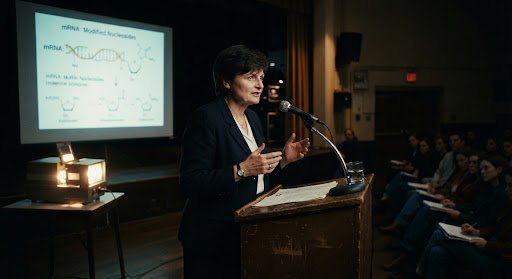
How the screening series is programmed
A season of women in history short films only works if the sequence argues something. We therefore build each programme around a question rather than a celebrity: what does persistence cost, who gets credit, and what changes once the record is corrected.
Because the programmes are drawn from the same roster as the written dossiers, a screening series never repeats a story without adding to it. For example, the opening episode on Katalin Karikó pairs with her dossier, and the related profiles beside it explain why the mRNA work mattered beyond one laboratory.
In addition, each screening series page links back into the five storytelling worlds and forward into the master story roster. As a result, a single screening becomes a route through the whole collection, and educators can plan a term of viewing without hunting for context.
Each screening series episode is checked against the original award citation, so the science on screen matches the record described by the Nobel Prize archive. The same screening series then feeds the written dossiers that sit behind the master story roster.
Inside a screening series programme
A screening series programme usually pairs two dossiers from different worlds, so the audience compares methods rather than milestones.